When Virtual Worlds Become Real Consequences: The Fine Line Between VR Passion and Life-Wrecking Obsession
Marcus, a 34-year-old software engineer from Austin, Texas, didn't plan on leaving a six-figure salary behind. He'd picked up a Meta Quest 3 on a whim, mostly to unwind after long sprints of coding. Six months later, he was putting in his two weeks' notice so he could spend more time developing inside a VR creative platform — not because he had a business plan, but because the virtual world had started feeling more real than his actual job.
"I know how it sounds," he admits. "But I'd get home, strap in, and suddenly the thing I was doing in there felt more meaningful than anything I'd done at my desk all day."
Marcus isn't alone. Across VR communities on Reddit, Discord servers, and dedicated forums, stories like his surface with surprising frequency — people who've rearranged entire lives around virtual commitments. Some quit jobs. Others have ended relationships, relocated, or restructured sleep schedules around in-game events. The question worth asking isn't whether these people are simply reckless. It's why VR specifically seems to push people to these edges in ways that a PlayStation controller or a PC monitor rarely does.
Why VR Hits the Brain Differently
The short answer is presence. The long answer is a lot more complicated — and a lot more worth understanding.
When you're playing a traditional video game, some part of your brain always knows you're sitting on a couch. The screen is a window. VR removes the window. Researchers studying immersive technology have consistently found that the brain's threat-response and reward systems activate more intensely in virtual environments than in flat-screen gaming. Your body genuinely believes, on some level, that what's happening is happening.
That's a feature, not a bug. It's what makes VR horror genuinely terrifying, VR fitness actually exhausting, and VR social spaces feel more intimate than a group text ever could. But it also means the emotional investment stakes are higher. When you accomplish something inside a VR world, the satisfaction registers closer to a real accomplishment. When you build relationships with people in VR multiplayer spaces, the bonds feel tangible.
And when that world starts feeling more rewarding than the one outside the headset? That's where things get complicated.
The Design Choices That Fan the Flames
It would be convenient to blame individual players for lacking discipline. It would also be lazy. The reality is that many VR titles are engineered — deliberately or not — to maximize the kind of deep engagement that bleeds into obsession.
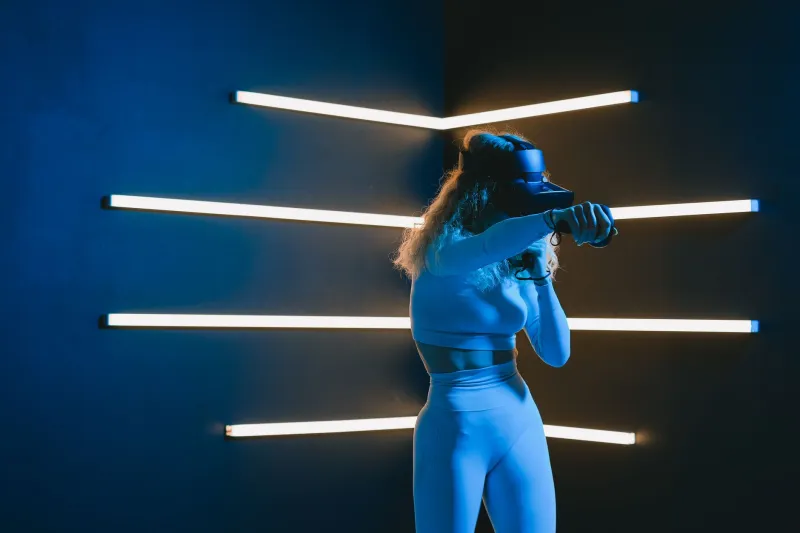
Progression systems in VR are particularly potent. Games like Walkabout Mini Golf, Eleven Table Tennis, and various rhythm titles build skill curves that feel genuinely athletic. You're not just leveling up a number — you're physically improving at something. That feedback loop is intoxicating in a way that's hard to replicate anywhere else. You feel yourself getting better, and that feeling doesn't stay in the headset when you take it off.
Social VR platforms compound this further. Worlds built on platforms like VRChat or Rec Room create communities with their own events, hierarchies, and inside cultures. For some users — particularly those who struggle with traditional social environments — these spaces offer a sense of belonging that the physical world hasn't delivered. Walking away from that, even for a few days, can feel like social abandonment.
Jenna, a 28-year-old graphic designer from Portland, describes spending upward of five hours a night in a VR social world after a rough breakup. "It wasn't escapism exactly," she says. "It felt like I'd found my people. I started turning down real-life plans because the things happening in-game felt more important."
She eventually stepped back — but not before her freelance work suffered noticeably.
When Passion Becomes a Problem
The tricky part is that the line between healthy enthusiasm and destructive obsession isn't always obvious from the inside. VR communities celebrate deep commitment. Logging hundreds of hours is a badge of honor. Knowing every corner of a game's world signals dedication, not dysfunction.
But there are tells. Sleep disruption is one of the earliest warning signs mental health professionals point to — and VR's immersive nature makes it uniquely effective at pulling players past reasonable hours. The headset blocks out the room, the notifications, the ambient cues that normally signal it's time to stop. Time distortion in VR is real; what feels like an hour can easily be three.
Relationship strain follows close behind. Several people we spoke with described partners or family members raising concerns long before they recognized the issue themselves. One player from Chicago — who asked to remain anonymous — said his wife's frustration didn't register until she used the phrase "you're not really here even when you're home."
"That one landed," he says quietly.
What the Industry Could — and Should — Do
Here's where it gets thorny for developers and platform holders. Engagement is the metric that drives revenue. More time in headset means more purchases, more subscriptions, more data. There's a direct financial incentive to design experiences that players can't put down.
But some studios are pushing back, quietly. Certain VR fitness titles have built-in session limits. Some social platforms have experimented with gentle usage reminders. A handful of developers have spoken openly at conferences about designing "off-ramps" — natural stopping points that respect the player's real-world obligations rather than fighting against them.
It's not a movement yet. But it's a conversation that's starting to happen, and it's one the VR space desperately needs.
Meta, Sony, and other major platform players haven't introduced meaningful system-level usage tools comparable to what Apple and Google offer on mobile devices. Given that VR is arguably more immersive than any smartphone experience, that gap feels increasingly hard to justify.
Finding the Balance Before It Finds You
Marcus, for his part, doesn't regret leaving his job — though he acknowledges the decision was driven more by VR-fueled emotion than cold logic. He's now building a small indie project inside the same platform that consumed him, which is either a redemption arc or a cautionary tale depending on how you look at it.
"I think VR showed me something real about what I actually wanted," he says. "I just wish I'd had a cleaner way to process that without blowing everything up to get there."
That's probably the most honest summary of VR's peculiar power. It doesn't manufacture feelings from nothing — it amplifies and clarifies the ones already buried underneath. The technology is extraordinary. The experiences are genuinely transformative. And that's exactly why approaching them without any self-awareness is a gamble with stakes that go well beyond your player profile.
The headset comes off. The rest of your life is still there when it does. Making sure you've left it in decent shape is, ultimately, part of the game.