Feeling Is Believing: How Next-Gen Haptic Tech Is About to Rewrite the Rules of VR
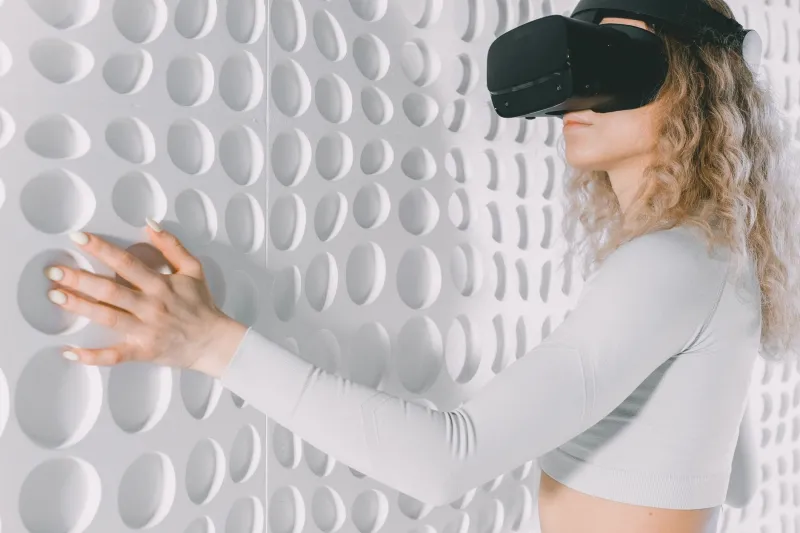
There's a moment every VR player knows. You're deep in a game, visuals are stunning, the audio is perfectly spatial — and then you reach out to grab something, your controller buzzes weakly in your hand, and the whole illusion quietly falls apart. That sad little vibration has been the Achilles heel of virtual reality since the beginning. But that's changing fast, and the technology leading the charge is more ambitious than most people realize.
Haptic feedback in gaming isn't new. Your DualSense already does some impressive stuff with adaptive triggers and nuanced rumble. But what's emerging in the VR space goes so far beyond that, it barely deserves the same name.
From Buzzing Controllers to Full-Body Sensation
The new generation of haptic hardware is designed to make your entire body part of the experience. Companies like bHaptics, Shockwave, and HaptX are building vests, gloves, and suits lined with arrays of actuators — tiny devices that can simulate pressure, texture, impact, and even temperature across dozens of points on your body simultaneously.
HaptX's gloves, for instance, use pneumatic micro-actuators and exoskeletal resistance to let you actually feel the shape and firmness of virtual objects. Pick up a heavy virtual crate and your fingers genuinely resist the grip. Touch a rough stone wall and the texture registers across your fingertips. It sounds like science fiction, but developers who've worked with early dev kits describe it as one of those rare moments where VR suddenly stops feeling like a game and starts feeling like somewhere you actually are.
bHaptics' TactSuit, which has been available in consumer form for a few years now, uses 40 vibrotactile actuators spread across a vest to simulate hits, explosions, and environmental effects across your torso. It already has integration with popular titles like Pistol Whip, Resident Evil 4 VR, and Arizona Sunshine. Players who've used it in horror games specifically describe the experience as genuinely unsettling — because a jump scare that you feel on your chest hits on a completely different neurological level than one you just see and hear.
Why This Changes Combat, Sports, and Puzzles Differently
The implications aren't uniform across game genres — haptic upgrades hit differently depending on what you're playing, and that's actually one of the more interesting angles here.
For VR combat games, the shift is obvious and visceral. Right now, sword-fighting in something like Blade and Sorcery is satisfying because of physics and audio design. Add genuine impact feedback when steel meets steel, or resistance when a blade meets a surface, and you've introduced a whole new skill dimension. Players would start reading hits through touch, not just sound. Developers working on combat-focused titles are already thinking about how force feedback could inform player strategy in ways that visuals alone can't communicate.
For sports games, haptics open up something closer to muscle memory training. A golf sim that lets you feel clubface contact, or a tennis game where the string tension of a volley registers in your arm — that's not just immersion, that's actual physical learning. The crossover potential with fitness-oriented VR is enormous, and several studios are reportedly experimenting with haptic integration specifically to make VR sports feel less like mimicry and more like the real thing.
For puzzle games, the angle is subtler but arguably more transformative. Right now, manipulating objects in VR puzzle titles requires you to trust your eyes entirely. Haptic gloves that let you feel the weight distribution of an object, or the click of a mechanism falling into place, add a tactile logic layer that puzzle designers have never had access to before. Imagine solving a lock-picking puzzle where you can actually feel the pins setting. That's a fundamentally different kind of engagement.
The Developers Leaning In
A handful of studios are already treating haptics as a first-class design consideration rather than an afterthought. Fast Travel Games, the Stockholm-based studio behind Propagation: Paradise Hotel, has been vocal about wanting tactile feedback to be part of their horror design language going forward. Meanwhile, indie developers building on platforms like Steam VR are increasingly building haptic profiles into their games even when the mainstream player base doesn't own the hardware yet — betting that adoption is coming.
On the hardware side, the conversation is shifting toward standardization. One of the biggest friction points right now is that every haptic peripheral speaks a slightly different language, which means developers have to build separate integrations for each device. Industry groups are starting to push for unified haptic APIs that would let a single implementation work across multiple suits, gloves, and controllers. If that happens, the floodgates open pretty quickly.
The Elephant in the Room: Price and Accessibility
Let's be real — right now, full haptic suits and high-end gloves are not living room consumer products. HaptX gloves have historically been priced for enterprise and research markets. Even bHaptics' more accessible TactSuit X40 runs around $500, which is real money on top of whatever you already spent on a headset and PC.
But the trajectory is familiar. Early VR headsets cost thousands. The Quest 3 starts at $499. Technology that starts expensive tends to get cheaper as manufacturing scales and competition increases. The question isn't really if haptic hardware becomes mainstream — it's when, and which platform gets there first.
Meta, Sony, and Valve are all watching this space. There are patents from multiple major players covering various forms of advanced haptic integration. And with Apple's Vision Pro pushing the idea that premium immersive hardware can find a consumer market, the pressure on the gaming side to deliver a truly complete sensory experience is only going up.
What Comes Next
The near-term roadmap is genuinely exciting. Ultrahaptic technology — which uses focused ultrasound to create tactile sensations in mid-air, without any wearable device at all — is moving out of research labs and into early commercial applications. That's the kind of leap that makes people stop and reconsider what VR hardware even looks like in five years.
For now, if you're a VR enthusiast with some budget flexibility and a taste for being on the cutting edge, experimenting with entry-level haptic vests is worth the investment. The game library is growing, the experience is genuinely different, and you'll understand immediately why the developers building for this hardware are so energized about where it's headed.
VR has always promised to put you inside the game. Haptic technology is the piece that makes that promise feel less like marketing and more like reality. The revolution isn't coming — it's already quietly underway, one actuator at a time.