The Honeymoon Is Over: Why VR Games Blow Your Mind at Hour One and Lose You by Hour Sixty
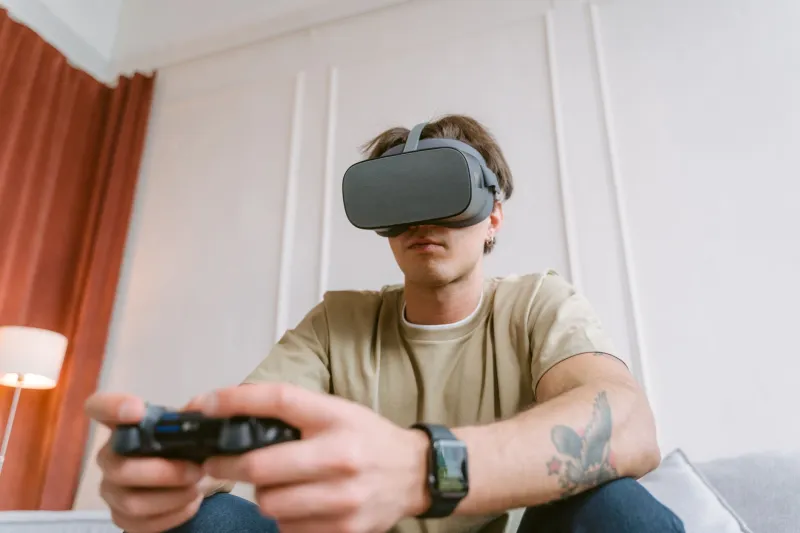
Ask anyone who's been into VR for more than a year about their most memorable gaming moment and they'll probably describe something from their first week in a headset. The first time they looked over the edge of a virtual cliff. The first time an enemy in a VR shooter reached toward them and they physically flinched. The first time a virtual world felt, even for a second, real.
Ask them what they've been playing lately, and there's a decent chance the answer is "not much."
This is VR's pacing problem, and it's one of the medium's most underexamined design failures.
Why the First Hour Hits Different
To understand why VR game design so consistently falls apart over time, you have to understand why it works so spectacularly at the start.
The initial VR experience is powered almost entirely by novelty — and novelty is a neurological cheat code. When your brain encounters something genuinely new, it floods your system with dopamine and attention. You're not just engaged; you're transfixed. Every small detail feels significant because your brain is actively trying to map this new environment, build new mental models, and figure out the rules of this unfamiliar world.
Game developers — consciously or not — lean into this heavily. Opening sequences in VR titles are almost universally front-loaded with sensory spectacle. Big vistas. Dramatic scale reveals. Moments designed specifically to make you say "whoa" out loud in your living room.
The problem is that novelty is a finite resource. Once your brain has mapped the environment and understood the rules, the dopamine faucet turns off. And if the game hasn't built sustainable engagement mechanics underneath the spectacle — if the wow factor is the game — you're left with nothing.
The Grind Nobody Warned You About
Look at the structure of most mid-to-long VR titles and you'll notice a pattern. Hours one through five: incredible. Hours five through fifteen: pretty good. Hours fifteen through thirty: fine, I guess. Hours thirty onward: you've moved on to something else.
The culprit is usually one of two things: repetitive gameplay loops that weren't designed with long-term engagement in mind, or narrative structures that can't sustain the weight of immersive pacing.
Traditional flat-screen games have solved the repetition problem in a bunch of ways — skill progression systems, emergent narrative, procedural generation, multiplayer variance. VR games have borrowed some of these solutions, but often implemented them in ways that feel bolted on rather than integrated. A rhythm game with a leaderboard isn't automatically a long-term engagement engine. A shooter with unlockable weapons doesn't automatically have a reason to keep you coming back at hour seventy.
There's also a physical factor that flat-screen games don't have to contend with: VR is tiring. The physical and cognitive demands of wearing a headset, tracking your movements, and maintaining presence mean that VR sessions are naturally shorter than traditional gaming sessions. Developers who design for long-form engagement without accounting for this reality are setting themselves up to lose players.
What Long-Form VR Actually Looks Like When It Works
The titles that do manage to hold players for significant hours tend to share a few characteristics that are worth examining.
Mechanical depth over spectacle is the first. Games like Beat Saber — which has held its player base longer than almost any other VR title — succeed because the core gameplay loop has genuine depth. There's always a harder song, a cleaner score, a more efficient movement pattern to chase. The novelty of the initial experience fades, but it's replaced by the satisfaction of genuine skill development. That's a sustainable engagement loop.
Community and social variance is another major factor. VR titles with robust multiplayer components — or strong modding communities — have a built-in novelty regeneration engine. Other players are unpredictable. New community-created content keeps the environment fresh. This is why VRChat, despite being technically rudimentary in many ways, maintains an active user base that many more polished titles can't touch.
Narrative pacing designed for the medium matters enormously. VR storytelling can't be adapted wholesale from film or flat-screen games — the pacing has to account for the immersive experience itself. Some developers have figured this out. Many haven't. When a VR narrative sequences its dramatic beats the way a movie would, it almost always feels wrong in the headset — too slow in the wrong places, too rushed where it should breathe.
The Novelty Trap Is a Trap Developers Keep Walking Into
Here's the frustrating part: the VR industry knows about this problem. It's discussed in development communities, referenced in postmortems, acknowledged in interviews. And yet new titles keep shipping with the same front-loaded structure, the same spectacle-first design philosophy, the same absence of sustainable long-form engagement.
Part of this is market pressure. VR games are often reviewed and discussed based on their initial impressions. A title that wows journalists in a two-hour demo will get better coverage than a slower-burning experience that takes ten hours to really click — even if the latter is ultimately more rewarding. Developers optimize for the demo experience because that's what moves units.
Part of it is also a genuine design knowledge gap. Building sustainable engagement in VR requires understanding the medium in ways that are still being figured out. The conventions that make long-form flat-screen games work — the pacing rhythms, the engagement curves, the ways players build habitual return behavior — don't translate directly to VR. Developers have to essentially reinvent those wheels, and not everyone has the time or resources to do it.
What It Would Take to Actually Fix This
The path forward isn't complicated to describe, even if it's hard to execute. VR developers need to build their engagement systems before they build their spectacle — to design for hour fifty before they design for hour one. They need to take seriously the physical realities of VR play sessions and structure their games accordingly. They need to invest in the kinds of social and community features that generate novelty organically over time.
Most importantly, they need to stop treating the wow factor as the product. It's the hook. It's not the game.
The best VR experiences are still ahead of us — titles that will hold players the way the greatest flat-screen games have, that will build communities and memories across hundreds of hours rather than just five. But getting there requires developers to be honest about where the medium is currently failing.
The honeymoon doesn't have to end this fast. It's just going to take some actual work to extend it.