Leveling the Playing Field: How VR Is Becoming the Most Inclusive Gaming Platform Around
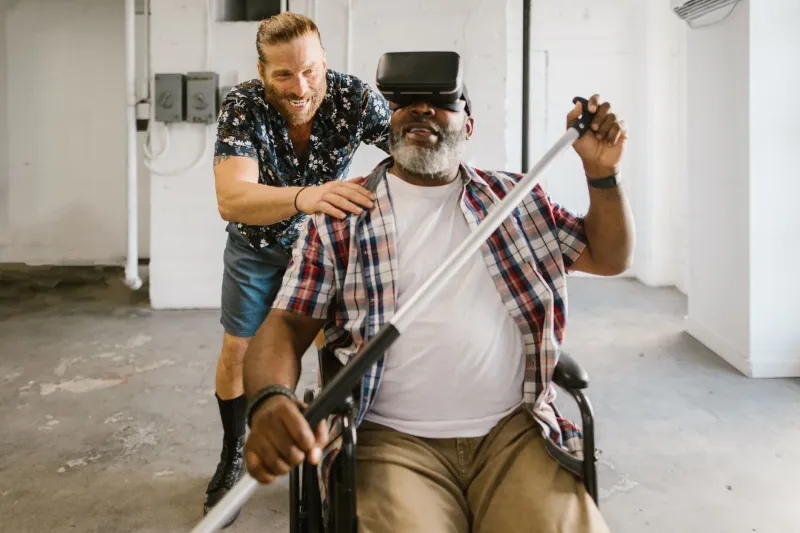
For years, virtual reality carried an unspoken asterisk. Sure, it was incredible — but it assumed you could stand, swing your arms, hear spatial audio cues, and tolerate motion without issue. For millions of American gamers living with physical, visual, or hearing disabilities, that asterisk felt less like a footnote and more like a locked door.
That door is finally starting to open.
A growing number of VR studios are treating accessibility not as a checkbox feature but as core design philosophy. The results are reshaping who gets to step inside a virtual world — and more importantly, who gets to stay.
Rethinking the Controller
One of the biggest friction points for players with limited mobility has always been the physical controller setup. Traditional VR demands two-handed motion, arm extension, and often full-body movement. For someone with upper limb differences, paralysis, or conditions like muscular dystrophy, that's a non-starter.
But studios are getting creative. Games like Moss and Lone Echo 2 have built gameplay loops that don't demand constant, symmetrical arm movement. Meanwhile, platforms like Meta Quest are expanding their controller-free hand tracking, which lets players interact with environments using subtle finger gestures rather than grip-and-swing mechanics.
Eye-tracking technology — already baked into headsets like the PlayStation VR2 and the Meta Quest Pro — is emerging as a genuine game-changer. For players who can't use their hands at all, gaze-based input offers a way to aim, select, and navigate that feels surprisingly intuitive once you spend a few hours with it. Developers building on these platforms are increasingly designing interfaces that treat eye-tracking as a primary input, not a novelty.
"We started thinking about eye-tracking as a cursor," said one indie developer working on an upcoming accessible VR title who asked to remain anonymous ahead of their launch. "Once you frame it that way, you realize a huge portion of your game's interactions can be rebuilt around it without losing any of the fun."
Hearing the Game Differently
For Deaf and hard-of-hearing players, VR presents a unique challenge: so much of immersion is built on spatial audio. Enemy footsteps. Narrative dialogue. Environmental storytelling through sound. Strip that away and a lot of VR experiences lose critical context.
Some studios are responding with visual audio cues — on-screen indicators that translate sound events into visible signals. Half-Life: Alyx, widely regarded as one of the best VR titles ever made, includes subtitle support and visual indicators for key audio moments. It's not perfect, but it's a meaningful baseline that more studios are using as a reference point.
Haptic feedback is another avenue getting serious attention. High-fidelity haptics — vibrations that vary in intensity, rhythm, and location — can communicate information that would otherwise come through sound. The PS VR2's DualSense-style haptic controllers are particularly well-suited for this, and developers experimenting with "haptic language" are finding ways to encode directional cues and narrative beats into physical sensation.
Tackling Motion Sickness Head-On
Motion sickness isn't always discussed in the context of disability, but for many players — including those with vestibular disorders, inner ear conditions, or neurological differences — VR-induced nausea isn't just discomfort. It's a hard barrier to entry.
The industry's response has been a toolkit of options: vignette modes that narrow your field of view during movement, teleportation locomotion as an alternative to thumbstick walking, adjustable turn speeds, and seated play modes. Titles like Pistol Whip and Resident Evil Village VR Mode offer robust comfort settings menus that let players dial in exactly how much physical simulation they can handle.
Meta has even built a comfort rating system into the Quest store, flagging experiences that are likely to cause motion discomfort. It's a simple feature, but for someone with a vestibular condition trying to find playable titles, it's enormously helpful.
Players Speaking Up — and Studios Listening
Much of this progress traces back to disability advocates within the gaming community who refused to accept that VR just "wasn't for them." Organizations like AbleGamers and SpecialEffect have been pushing the broader gaming industry toward better accessibility for years, and their influence is reaching VR.
Jamie, a 34-year-old gamer from Ohio who has been deaf since birth, told us that VR has become one of the few gaming spaces where she feels genuinely considered. "When a game gets the visual cues right, it's not just playable — it's actually more immersive for me because I'm not constantly having to guess what I missed," she said. "I can be in it."
That sense of presence — the core promise of VR — is exactly what good accessibility design protects. When the controls, the audio design, and the locomotion options account for a wider range of players, the immersion doesn't break. If anything, it deepens.
Which Titles Are Worth Your Time
If you're looking for VR experiences that genuinely walk the accessibility walk, a few titles stand out:
- Moss & Moss: Book II — Seated-friendly, controller-optional in some interactions, and beautifully paced for players who need more time.
- Half-Life: Alyx — Robust subtitle support and one of the most polished comfort-setting menus in the medium.
- Supernatural — Offers seated workout modes and adjustable intensity, making it more accessible than it first appears.
- Puzzling Places — A relaxed, seated puzzle experience with no time pressure, no combat, and no motion locomotion required.
The Road Ahead
VR accessibility is still a work in progress. There's no universal standard, no equivalent of the WCAG guidelines that web designers follow. Every studio is largely making it up as they go, which means the gap between the best and worst experiences is enormous.
But the momentum is real. As headsets get more capable, as eye-tracking and hand-tracking mature, and as the community of disabled VR players grows louder and more visible, the pressure on studios to do better will only increase.
At IgnisVR, we think the best version of virtual reality is one where "immersive" doesn't come with an exclusion list. The technology is getting there. The developers are getting there. And the players who've been waiting patiently at the door? They're ready to step through.