More Than Avatars: How VR Multiplayer Is Quietly Building Some of the Most Genuine Friendships in Gaming
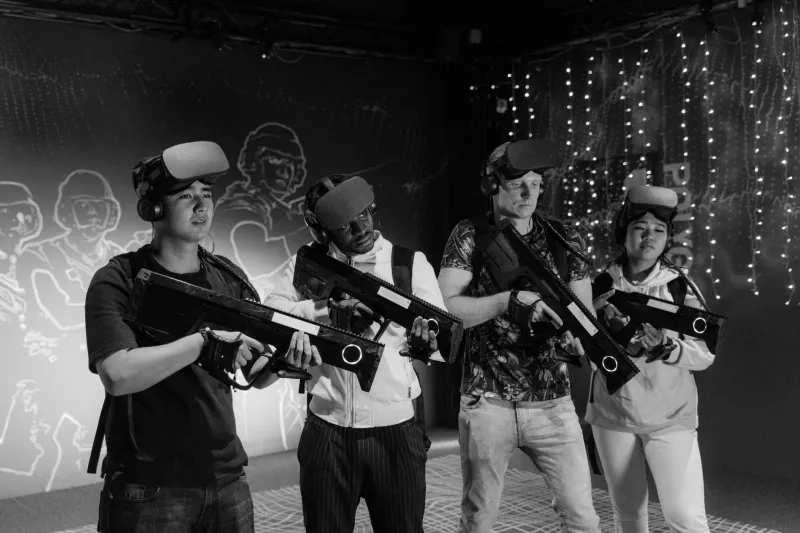
Picture this: it's 11 p.m. on a Tuesday, and two strangers are crammed into a virtual escape room somewhere between the Pacific and Eastern time zones. One of them is a nurse from Ohio; the other is a software developer from Portland. They've never met. But forty minutes later, after solving puzzles together, laughing at each other's panicked hand gestures, and narrowly escaping a digital countdown clock, they're exchanging Discord handles.
That's not a staged marketing moment. That's a Tuesday night in VR.
Multiplayer gaming has always promised connection, but for most of its history, it delivered something a little colder — usernames, kill-death ratios, and the occasional trash talk over a headset. VR is doing something different, and players who've spent real time in shared virtual spaces will tell you the gap between "online friend" and "actual friend" feels a lot narrower when you're standing next to someone's avatar, watching their hands move.
Why VR Multiplayer Feels Different From the Ground Up
The obvious answer is presence — the sense that you are somewhere, not just playing a game. But presence alone doesn't explain why VR friendships form the way they do. The real magic is in the body language.
In a traditional multiplayer game, your social cues are limited to what you type or say. In VR, you wave, you point, you lean in when you're curious, you flinch when something surprises you. These micro-expressions happen automatically, without any conscious input from the player. And the people around you read them the same way they would in the real world.
Researchers studying social VR have noted that users tend to apply real-world social norms — personal space, eye contact, turn-taking in conversation — even when they know they're in a virtual environment. That's not a bug. That's the platform doing something that a flat screen simply can't replicate.
"There's a moment where you stop thinking about the tech and just start talking to someone," said Marcus, a 34-year-old teacher from Austin who's been playing on Meta Quest for about two years. "I've got friends I met in Horizon Worlds who I talk to every week. We've never been in the same city, but I know their kids' names. I know when they're stressed. It doesn't feel like a game friendship — it feels like a friendship."
The Platforms Making It Happen
Not every VR experience is built for connection, but the ones that are have become genuinely vibrant communities.
Rec Room remains one of the most socially active VR platforms in the US, and it's not hard to see why. Its blend of mini-games, user-created rooms, and casual hangout spaces gives players a reason to keep coming back — and something to do together while they talk. The game doesn't force interaction; it just creates the conditions for it.
VRChat takes a wilder approach. With its user-generated worlds and near-infinite avatar customization, it's become a cultural phenomenon in its own right, spawning its own slang, communities, and even support groups. Yes, it can be chaotic. But chaotic shared experiences are, historically, how a lot of great friendships get started.
Walkabout Mini Golf might be the sleeper hit of the social VR space. Strip away the fantasy and what you've got is basically a virtual version of one of America's most classic low-pressure hangout activities. You're not competing intensely. You're just hanging out, taking turns, and talking. That relaxed rhythm turns out to be a surprisingly powerful friendship accelerator.
What Developers Are Getting Right (and What Needs Work)
The studios building the best social VR experiences seem to understand one key thing: the game is almost secondary. What they're really designing is a context — a reason for people to be in the same virtual space long enough to let something human happen.
The best social VR spaces offer low-stakes activities, customizable environments, and tools that make it easy to find people with shared interests. They also tend to have strong moderation, which matters more in VR than anywhere else. When someone violates your personal space or harasses you in a virtual environment, it can feel more visceral than a mean comment on a forum. Platforms that take this seriously — with clear reporting tools and active community management — tend to retain healthier, more engaged player bases.
The area that still needs the most work? Discovery. Right now, finding your people in VR often depends on luck or already knowing someone who plays. Better matchmaking systems built around personality, interests, or even play style could dramatically accelerate the community-building that's already happening organically.
The Friendships That Surprised People Most
Talk to enough regular VR multiplayer players and a pattern emerges: the friendships that hit hardest are the ones nobody expected.
Jenna, a 29-year-old graphic designer from Chicago, started playing VR during the pandemic when in-person socializing wasn't an option. "I was honestly just looking for something to do," she said. "I ended up in this little VRChat world where people were just watching movies together and talking. I met someone there who's now one of my closest friends. We've met in person twice. It still kind of blows my mind."
That story — VR as an unexpected entry point to a real relationship — comes up again and again. And it points to something worth sitting with: virtual spaces aren't a substitute for human connection. They're a venue for it. The connection itself is as real as any other.
What This Means for the Future of VR Gaming
As headsets get lighter, more affordable, and more mainstream, the social layer of VR is only going to grow. Developers who figure out how to design for genuine human connection — not just engagement metrics — are going to be the ones who build lasting communities.
For now, though, the most compelling thing about VR multiplayer isn't the technology. It's the nurse from Ohio and the developer from Portland, still in a Discord server together two years later, planning their next game night.
That's the revolution. And it's already well underway.