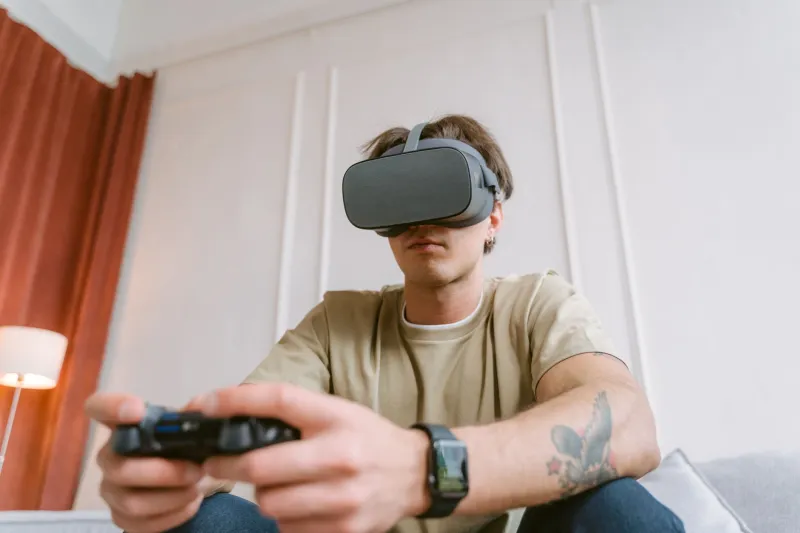
Your Couch Is a Level Now: How Mixed Reality Is Finally Designing for Messy Living Rooms

Photo: Jinoy Tom Jacob, CC BY-SA 4.0, via Wikimedia Commons
The living room is the level now
For years, VR level design started with a blank canvas. Developers built floating temples, sci-fi corridors, and impossible architecture, then dropped the player inside. Room-scale changed the scale of that fantasy, but it still treated the real world as a boundary to be drawn around. Mixed reality flips the equation. The room is not the border anymore. The room is the level.
That shift sounds like a marketing line until you watch someone play a good MR game in their actual apartment. The couch stops being clutter and becomes cover. The coffee table stops being an obstacle and becomes a puzzle surface. The doorframe stops being a wall and becomes a portal. The best 2026 mixed reality titles treat your home like a co-designer, not a liability.
The tricks that make a messy room playable
The first trick is surface snapping. Instead of asking players to clear a six-foot circle, MR games scan the room and attach virtual objects to real surfaces. A virtual cauldron sits on the actual side table. A dartboard hangs on the actual wall. A control panel locks onto the kitchen counter. When the mapping is good, the illusion is not that the virtual object is real — it is that the virtual object belongs there.
The second trick is affordance substitution. A developer cannot assume every player has a dedicated play space, so they design interactions around whatever furniture is already present. A low table becomes a crafting bench. A bookshelf becomes a spell library. A couch becomes a safe zone where enemies will not follow. This is level design as negotiation. The game asks what your room can offer instead of demanding that you rebuild it.
The third trick is soft boundaries. Older VR games shouted at you with a grid when you got close to a wall. MR games are learning to fade virtual geometry, dim the passthrough, or nudge the player with diegetic cues. A virtual character steps aside. A doorway glows. A voice says the room is getting tight. It is less jarring, and it keeps players inside the fiction instead of yanking them into a safety tutorial.
Occlusion matters just as much. When a virtual object correctly disappears behind your real couch, your brain buys the depth. When it floats on top of the couch like a sticker, the whole scene collapses. The same is true for lighting. A virtual lamp that casts no glow on your actual wall feels wrong in a way players cannot always articulate. The best MR developers are spending as much time on shadow and bounce light as they are on polygon counts.
Pet mode is now a real design category. Dogs walk through play spaces. Cats sit on the exact square of floor where the final boss was supposed to spawn. Some games pause when a pet enters the play area. Others route virtual enemies around moving obstacles. A few use the pet as a feature, turning your dog into a friendly NPC who wanders through the level. It is chaotic, and it is exactly what home play looks like.
Where the illusion breaks
Mixed reality still fails in ordinary rooms. Low light confuses the cameras. Mirrors and glass create phantom geometry. Clutter turns a clean mesh into a noisy mess. A room that looks tidy to a human can look like a rock slide to a headset. Players learn to tidy up before sessions, which is a design failure in disguise. If your game requires a showroom, you have not solved the living room problem.
Mesh drift is another issue. Scan a room once and it looks solid. Move a chair and the virtual table may hover where the old chair used to be. Re-scanning helps, but it interrupts play. Spatial anchors are improving, yet they are not magic. A doorframe that was a portal five minutes ago can become a wall if the headset loses its place.
Privacy is the quiet complication. Passthrough cameras see more than players remember. A game that scans your bedroom for level geometry is also collecting data about your bedroom. Developers need to be clear about what stays on the device and what leaves it. The funniest MR demo becomes uncomfortable fast when a player realizes the virtual window is framed around their actual laundry pile.
Why this is the biggest shift since room-scale
Room-scale made VR physical. Mixed reality makes it personal. Designers can no longer fake scale with a skybox. They have to negotiate with the player's actual life: the sectional couch, the roommate walking through, the dog who wants attention, the apartment that is technically one room. That is harder, messier, and far more interesting than another floating temple.
The winning mixed reality games will be the ones that make the couch feel like a feature, not a bug. They will design for the home people actually live in, not the home a focus group imagines. Your living room is already a level. The best developers are finally learning to play in it.