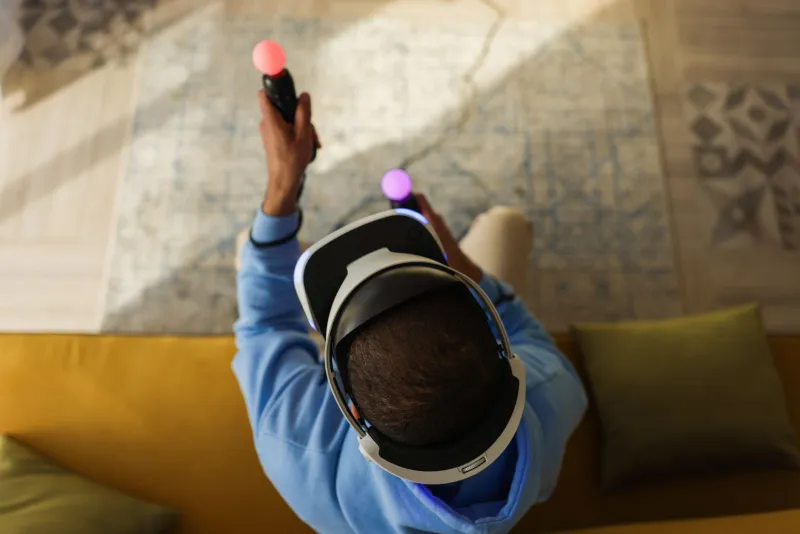
Playing Through the Pain: The Very Real Physical Toll That VR Gaming Is Taking on Players' Bodies

Somewhere around the ninety-minute mark of an intense session in a VR sword-fighting game, your arm stops feeling like your arm. The burning starts in your forearm, creeps up through your elbow, and by the time you finally pull the headset off, your wrist has that deep, unhappy ache that suggests you may have done something you'll regret tomorrow. You shake it off, drink some water, and figure you'll be fine.
A week later, you're icing your elbow before bed and Googling "tendonitis symptoms."
This scenario is playing out in living rooms across the country more often than the VR industry likes to acknowledge. The medium's greatest strength — the fact that it actually moves your body — is also generating a category of gaming injury that didn't exist before, and that neither players nor developers have fully reckoned with.
Why VR Hits Different (In the Wrong Way)
Traditional gaming is hard on your wrists, your posture, and your eyes. VR is hard on all of those things plus your shoulders, elbows, forearms, knees, and lower back. The difference is simple: instead of pressing buttons with your thumbs, you're swinging, punching, slashing, ducking, and reaching for extended periods.
The human body is reasonably well adapted to moving. What it's less well adapted to is performing the same movements repeatedly at high intensity for an hour or more. That's the definition of repetitive strain injury — the kind of damage that builds up gradually until something that felt fine suddenly, very much doesn't.
Physical therapist Dana Kowalski, who practices in the Chicago area and has treated several VR-related injuries over the past two years, describes the pattern she's been seeing: "What I'm noticing is that people come in with presentations that look like tennis elbow or pitcher's shoulder, but they're not athletes. They're gamers. When I ask about their activity history, VR keeps coming up."
The specific injuries vary by game type, but a few patterns emerge consistently.
The Usual Suspects: Which Games Are Doing the Most Damage
Rhythm games like Beat Saber are among the most frequently cited culprits, and the reason is straightforward: they're designed to keep you moving at high intensity for long stretches, the motion is highly repetitive, and they're genuinely fun in a way that makes it easy to ignore warning signs. The slashing motion involved activates the same muscle groups as racket sports, and players who go hard without adequate warm-up are essentially doing a high-rep forearm and shoulder workout without any of the preparation an athlete would consider mandatory.
Combat games — particularly those with realistic weapon physics — generate a different injury profile. The rotational forces involved in swinging a virtual sword or axe, especially when players are trying to maximize power, put significant stress on the tendons around the elbow and the rotator cuff. Players who've spent years in flat-screen gaming have essentially zero conditioning for these movements, and the transition from zero to full intensity is where most injuries originate.
VR fitness games present their own category. Games designed explicitly to provide a workout — boxing titles, full-body cardio experiences — are upfront about their physical demands, but they're often used by people who are specifically trying to get in shape, meaning their bodies are even less prepared for the load than an experienced gamer's would be.
"The issue I see most with VR fitness games is people treating them like a regular workout without any of the structure," says Marcus Webb, a personal trainer in Austin who has incorporated VR into some of his clients' programs. "No warm-up, no cool-down, no progressive overload principles. They just go full intensity from day one because the game makes it fun, and then they wonder why their shoulder hurts three weeks later."
The Rage Quit Factor
There's a psychological dimension to VR injuries that doesn't have a clean equivalent in traditional gaming. When you're frustrated in a regular game, you might grip the controller harder or slam it on the armrest. In VR, frustration translates directly into physical intensity. You swing harder. You lunge more aggressively. You make movements that are mechanically sloppy in ways that increase injury risk.
Several players interviewed for this piece described injury moments that happened specifically during moments of competitive frustration — a failed attempt in a rhythm game at a high difficulty tier, a losing streak in a VR combat title, a boss fight that kept ending badly. The emotional spike triggered a physical spike, and that's when something went wrong.
This is a genuinely new dynamic in gaming. The rage-quit moment has always been emotionally intense, but it's never before had direct physical consequences for the person experiencing it. In VR, the gap between emotional state and physical expression closes in ways that create real risk.
What Physical Therapists Actually Recommend
The good news is that VR-specific injuries are largely preventable with some straightforward adjustments to how you play.
Warm up like you mean it. Before a session with any physically demanding VR title, spend five to ten minutes doing light arm circles, shoulder rolls, wrist rotations, and gentle stretching. It feels excessive until it saves you a month of recovery time.
Set hard time limits. Most physical therapists recommend treating VR sessions the way you'd treat any exercise session — build up duration gradually, don't exceed sixty to ninety minutes of high-intensity play without a significant break, and listen to your body when it signals fatigue.
Pay attention to form. This is harder in VR because there's no coach watching, but sloppy mechanics — overextending on swings, using your back instead of your core for stability, locking your elbow on impact — are where injuries start. Slower, more controlled movements are almost always safer than maximum-effort swings.
Don't play through pain. This seems obvious, but the immersive quality of VR makes it easier to ignore discomfort signals than almost any other activity. If something hurts, stop. The game will still be there after you've recovered. A tendon that gets ignored long enough won't be.
The Developer Side of the Problem
It's fair to ask whether VR game developers bear some responsibility here. The answer is nuanced.
A handful of studios have started incorporating rest prompts and session length recommendations directly into their games — Beat Saber has added some warnings, and certain fitness-focused titles include explicit guidance about physical preparation. But these are exceptions rather than norms, and the warnings that do exist tend to be easily dismissed.
There's an argument that developers have a genuine incentive to encourage longer sessions — more engagement means better retention metrics — that works directly against the player's physical wellbeing. Whether that tension gets resolved through industry self-regulation, platform-level requirements, or something else entirely remains to be seen.
What's clear is that the "it's just a game" framing that has always given traditional gaming a pass on physical health concerns doesn't apply to VR. When the game moves your body, the game is responsible for what happens to your body. That's a new kind of accountability, and the industry is still figuring out what to do with it.
The Bottom Line
VR gaming's physical intensity is one of its most compelling features. The fact that it gets you moving, raises your heart rate, and demands real physical engagement is a genuine selling point — and for a lot of players, it's what makes the medium feel revolutionary rather than just novel.
But that intensity comes with a physical price that needs to be taken seriously. The players showing up in physical therapists' offices with VR-related injuries aren't outliers or people who did something obviously stupid. They're regular gamers who didn't realize the rules had changed.
The rules have changed. Your body is in the game now. Treat it accordingly.